It was earlier this year when I realized that the song in the video above, “Fight the Power” by Public Enemy, was twenty years old. I remember when I was first introduced to Public Enemy back in high school. My friend Adam put on the album “Apocalypse 91… The Enemy Strikes Black” while we were playing video and board games. It was the first time I had been exposed to hip hop and shortly thereafter it became the first hip hop album I bought. I had never listened to any band with a social and political agenda before Public Enemy. “By the time I get to Arizona”, “Can’t Truss It”, and “Shut’em Down” were like shots being fired across my world perception bow born from my very mundane suburban living. I knew things were not right in the urban community, but I had never heard it told from street perspective. This cultural grain of salt has stayed with me through the years. However, like a lot of my fickle music interests as a teen, the album got heavy play for a month and then retired to a CD folder, rarely to be heard again.
I’ve been thinking about “Fight the Power” recently since I bought the Public Enemy retrospective “Power to the People”. I’ve been playing it on my iPod when I’ve been working on ideas for the library that has been resisted in the past. While the song is more closely identified with a call for racial equality, I thought this article from Salon about the song and its impact said it best: “When Public Enemy called us to battle, it revived the notion that it just might be possible to fight the system. At the very least, we knew it was necessary.”
 In the last couple of weeks, I’ve been keenly following the state budget battle out in Ohio. Governor Strickland had announced a 50% cut in funding to libraries as part of his proposed budget. Since a majority of libraries are state supported, this would mean the crippling and/or closing of many libraries around the state. I’ve joined and contributed to the Save Ohio Libraries Facebook group that was set up in order to organize rallies, distribute state legislator contacts, and public lobbying of the Governor. The genesis of this group has been phenomenal as it gained over 20,000 members in the first week (the current tally as of the time of this post is roughly 45,000). It is full of photos, links, video, and active postings on the wall and in the discussion boards. While I have not received a message from the group creator, I have been checking it (as well as following #saveohionlibraries on Twitter) for updates as to how things are working out. I can’t say that my posting presence on this massive group has gone unnoticed.
The other night, I got a Facebook message from an Ohio resident which read:
Why posting about Ohio libraries if u r in NJ? My grandchild here in Cleveland can lose her storytime, yours?
My reply to her was:
Because libraries are important, regardless of state borders. I just want to show my support!
NJ has some budget cuts, but we aren’t in the same trouble as Ohio libraries!
Her last message thanked me for my involvement, but this whole series of events has been fascinating. This certainly is not the first time that social media has risen to a grassroots cause, but it was the first time I experienced it from a front row seat. It held me in rapt attention in the evening for most of last week as the number of group members climbed and people started offering their words, links, and other forms of support. In concert with libraries all over the state and the Ohio Library Council, this virtual march ran as a prelude to actual ones. These Buckeyes, proud and defiant, have focused the outrage of the populace into political action. (As of the time of writing, the budget is still in the air.)
As engrossing as this whole situation was to watch unfold in the belly of social media, it was during a drive up to work where I had a thought that gave me significant pause: why is it that the library community can be this organized and passionate when it comes to budget battles and less visible during other times? (With the exception of book challenges, possibly.) Does it take being pushed to the brink of non-existence to ignite the fire in our bellies for our profession and rally the public to our noble cause? What can be done now to prevent putting ourselves in this position in the future?
As it can be expected, I have a few ideas.
We need to radically reframe the public and political dialogue about libraries. How? By advocating that libraries are an essential service of a modern industrialized society. Information literacy has become a new set of basic skills for people living in the developed world. Even if a job does not require them, it is more than likely you will need them to apply to that job as businesses move their employment applications online. Data is the new goal of our hunting and gathering ways, whether it is to determine the lowest airfare available, how to contact an old friend, or find out what the weather will be like tomorrow. Our materials (print, video, audio, web) are fuel for the human curiosity engine that resides in all of us.
We educate, enrich, and enhance the lives of our patrons. Whether it is through materials or programs, computers or classes, or simply being there for our patrons when they are looking for someone to talk to, libraries matter to their communities. There is no private or government entity nor internet service or website that equates to the personal service we offer or the depth and breadth of information we can access. Our role in society is unduplicated, unequaled, and undisputed in this new age of information.
Therefore, we are essential.
In order to broadcast this type of message, it is pressing that we believe in it ourselves. There can be no false enthusiasm or facade to this belief; it must be complete and genuine. Personally, in seeing the passion presented by my peers at conferences and gatherings, this is perhaps the easiest aspect that I am proposing. However, I can see how it would be a true barrier in a world that minimizes and marginalizes the very mission of the library. It is imperative to rise above the critics, to instill ourselves with confidence about our restless profession, and to take pride for our service and toil on behalf of our patrons. For if we don’t believe that we are essential to the public, why should they believe it themselves?
From this, I see the hardest yet most rewarding part: a sustained public movement towards the safeguarding and custodianship of the public library and its ideals. While moving towards this goal can feel Herculean, we are already surrounded by the necessary building blocks.
Some of these are more familiar and “traditional” methods of building relationships with the community by getting to know your patrons and politicians. A Friend’s group can work as an extension of the library as each member becomes an ambassador of the library. Local media in the form of newspapers and radio stations provide a broadcast platform to reach out to the community. Encourage local politicians to define a stance on the library and library funding and invite them to come and see the collection for themselves. In addition, any marketing campaign that can be run (alone or in conjunction with a Friend’s group) at the community level should work to raise the visibility of the library. These tried and true methods are pretty universal for libraries around the country.
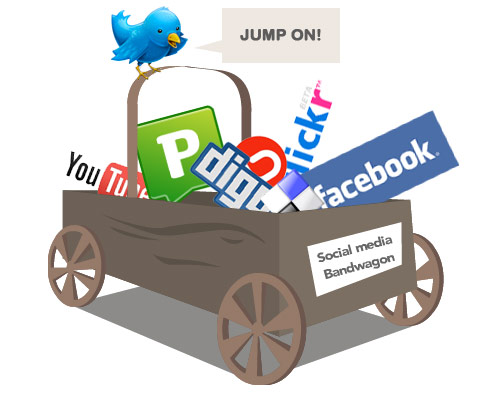
On the other hand, there are the exciting new methods possible through web 2.0 social media. Witnessing the growth and development of the Save Ohio Libraries Facebook group has really reinforced this concept with me. For the price of time and effort, you can create content that can be used to reach out and interact with patrons far beyond the walls of the library. It is this extension into the lives of our patrons as a relevant and important service that will ensure the survival of the local library in the future. It latches onto the underlying appeal of constant and immediate contact as offered by text messages, email, and Facebook or Twitter-like updates. With the improvement of our communication technologies, this is the opportunity to groom this technological type of relationship with people. As communication methods grow, as different types of web based social networking appear, and as the product of information evolves, the library needs to be in step with these advances. Our patrons are moving along with the improvements, and so should we.
The difference between the traditional methods and web 2.0 social media is that the latter is more personal since the conversation never ends. Beyond the aforementioned constant contact, it becomes a part of the information lifestyle that people have grown accustomed. We meld into the other popular web services that people use to manage their daily lives. The ability to order groceries online coincides with placing materials on hold; watching YouTube becomes no different than watching a movie on Overdrive; and calling or emailing the reference desk is seen as an upgraded internet search. Not only are the tools on hand, but there are more being developed and refined with each passing software innovation cycle. Twitter, Jaiku, Facebook, Myspace, Flickr, Picasa, Blogger, Livejournal, these are examples of social media of today; can you imagine what is down the road from these illustrious starting points? We will never lose the personal touch that is exemplified by more traditional patron relationships, but we should work to enhance it through the communication and information technological wonders of social media.
For librarians looking towards the future of the public library, now is the time to create our own functional social networks for advocacy. Now is the time to forge new friendships and connections with librarians both local and national. And now is the time to share experiences and knowledge resources when it comes to organizing the library grassroots. It is through these bonds that we can support one another during the inevitable crises that play out across the country when the ideals of intellectual freedom are endangered, when our content is challenged, and when our very existence in the community is threatened. Librarians call upon each other to help with a reference question; how can we not call upon others to help one another weather the ideological storms? Our professional egalitarian ideals should not mean that we treat everyone equally yet suffer all of the hardships alone. We are now one immense information sharing entity, intricately connected through phone and ethernet. The closing of one library is a loss of a unique community resource to the whole system and we should treat it as such.
This is not a call to replace specialty or state library associations in their advocacy roles, but to supplement them. Our assets are thousands of additional eyes and ears with computer savvy capable of finding and reporting information back to the others. It is an intelligence network staffed by passionate library professionals that extends wherever a library stands. With the increasing ease of user content creation, information sharing has never been easier for those who are bold enough to utilize it. This is a strength that we should seek to use for the benefit of libraries from coast to coast.
(In terms of the ALA, at least one person I know doesn’t think that the ALA is doing enough. I don’t really know enough about the organization to make any declarative statements, but I have been watching for their actions and words during the Ohio budget crisis.)
I realize in closing that the latter half of this post is more passion than substance in calling for a change in our collective course of action. But passion is the unquenchable thirst that drives each and every one of us to go farther and reach higher, whether as a librarian, an athlete, a parent, or just to be a better person. And library advocacy has become my passion, much in the same way that you can hear it in the voices of the testimonials in this video from NYPL.org:
So, who is with me?


Recent Comments