To address this question, a recent meta-analysis of 166 studies, including 75,269 participants of 34 countries, explored the so-called “privacy paradox,” that is, the puzzling fact that people’s concerns about privacy rarely appear to translate into protective behaviors. Contrary to previous studies, the findings of the meta-analysis revealed that individuals who are more concerned with and informed about privacy tend to use fewer online services, set stronger security settings, and disclose less personal information. However, when it comes to social media use, there is indeed a privacy paradox, as even individuals who express concerns behave quite carelessly, engaging in uncensored or inappropriate self-disclosure, making a great deal of their digital footprint public, and allowing a wide range of external apps to access their data. It has been estimated that nearly 40% of Facebook content is shared according to the (rather unsafe) default settings, and that privacy settings match users’ expectations only 37% of the time. Thus, it appears that no amount of privacy concerns will make social media users more cautious.
EBooks
The most important part of Facebook’s disinformation strategy is what it leaves out
But what we’re left with is the real prospect of foreign powers manipulating public discourse, and no clear way to fix it. As with false reporting, Facebook has laid out a plan for more aggressive action against fake accounts, but it’s running up against more serious limits. Even more than false information, disinformation campaigns happen largely outside of Facebook’s control. What should be a reassuring document ends up as an admission of defeat. This is what Facebook can do to fight the problem — and what it can’t do. The bigger message may be that if we want to protect public discourse, we’ll need more than algorithms.
From The most important part of Facebook’s disinformation strategy is what it leaves out – The Verge
UK Book sales hit a record as children’s fiction gains in popularity
Children’s fiction helped drive UK book sales to a record £3.5bn last year, the Publishers Association (PA) has said.
The 6% rise came despite the waning popularity of ebooks, which saw sales fall by 3% to £538m last year.
Sales of children’s books rose 16% to £365m, with the increase due mainly to the purchase of printed works.
From Book sales hit a record as children’s fiction gains in popularity – BBC News
The rise of reading analytics and the emerging calculus of reader privacy in the digital world
This paper studies emerging technologies for tracking reading behaviors (“reading analytics”) and their implications for reader privacy, attempting to place them in a historical context. It discusses what data is being collected, to whom it is available, and how it might be used by various interested parties (including authors). I explore means of tracking what’s being read, who is doing the reading, and how readers discover what they read. The paper includes two case studies: mass-market e-books (both directly acquired by readers and mediated by libraries) and scholarly journals (usually mediated by academic libraries); in the latter case I also provide examples of the implications of various authentication, authorization and access management practices on reader privacy. While legal issues are touched upon, the focus is generally pragmatic, emphasizing technology and marketplace practices. The article illustrates the way reader privacy concerns are shifting from government to commercial surveillance, and the interactions between government and the private sector in this area. The paper emphasizes U.S.-based developments.
Radioactive, yes, Radioactive Archives
You guessed it, the notebooks of Marie Curie.
Via Open Culture, here’s a report on the papers and other belongings of the discoverer of polonium and radium, Marie Curie who worked in her future husband Pierre’s lab. (I love that movie).
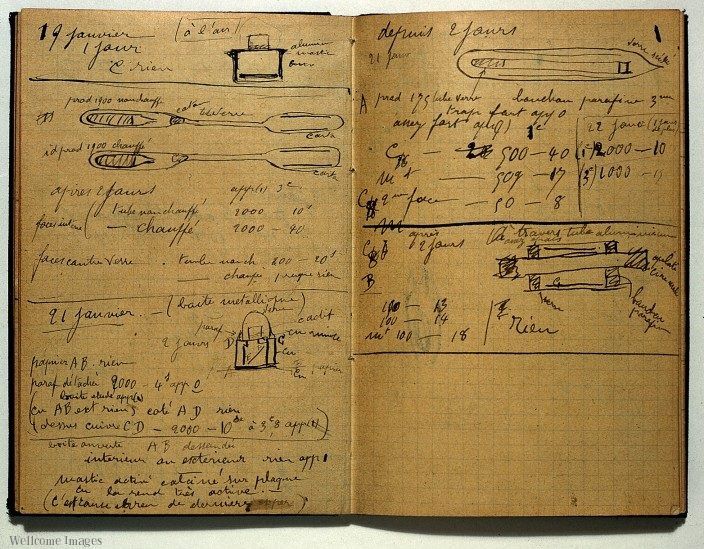
Her notebooks, her clothing, her furniture, pretty much everything surviving from her Parisian suburban house, is radioactive, and will be for 1,500 years or more.
If you want to look at her manuscripts, you have to sign a liability waiver at France’s Bibliotheque Nationale, and then you can access the notes that are sealed in a lead-lined box.
Printer’s Error


Printer’s Error: Irreverent Stories from Book History
Since the Gutenberg Bible first went on sale in 1455, printing has been viewed as one of the highest achievements of human innovation. But the march of progress hasn’t been smooth; downright bizarre is more like it. Printer’s Error chronicles some of the strangest and most humorous episodes in the history of Western printing, and makes clear that we’ve succeeded despite ourselves. Rare-book expert Rebecca Romney and author J. P. Romney take us from monasteries and museums to auction houses and libraries to introduce curious episodes in the history of print that have had a profound impact on our world.
The Card Catalog: Books, Cards, and Literary Treasures


The Card Catalog: Books, Cards, and Literary Treasures
The Library of Congress brings booklovers an enriching tribute to the power of the written word and to the history of our most beloved books. Featuring more than 200 full-color images of original catalog cards, first edition book covers, and photographs from the library’s magnificent archives, this collection is a visual celebration of the rarely seen treasures in one of the world’s most famous libraries and the brilliant catalog system that has kept it organized for hundreds of years. Packed with engaging facts on literary classics—from Ulysses to The Cat in the Hat to Shakespeare’s First Folio to The Catcher in the Rye—this package is an ode to the enduring magic and importance of books.
Book at Publisher’s website –The Card Catalog: Books, Cards, and Literary Treasures
The Card Catalog: Books, Cards, and Literary Treasures (Amazon)
The Book Thieves


For readers of The Monuments Men and The Hare with Amber Eyes, the story of the Nazis’ systematic pillaging of Europe’s libraries, and the small team of heroic librarians now working to return the stolen books to their rightful owners.
Getting Kids to Read the Stuffed Animal Way
Via CNN.

West Orange NJ’s childrens librarian Faith Boyle read “Knuffle Bunny: A Cautionary Tale” by Mo Willems to a group of children and their fluff-filled companions. After that late afternoon story time, the children kissed their toys good night.
A group of teenage volunteers quickly got to work, snapping photos of the stuffed animals in the library. There were images of a teddy bear and bunny holding hands while watching a puppet show and a tiny plush alligator reading about swamps. Even the photos of the monkeys sneaking Chips Ahoy cookies from the break room made it onto the library’s Facebook page.
Thieves steal £2m of rare books by abseiling into warehouse
Antiquarian books worth more than £2m have been stolen by a gang who avoided a security system by abseiling into a west London warehouse.
The three thieves made off with more than 160 publications after raiding the storage facility near Heathrow in what has been labelled a Mission: Impossible-style break-in.
The gang are reported to have climbed on to the building’s roof and bored holes through the reinforced glass-fibre skylights before rappelling down 40ft of rope while avoiding motion-sensor alarms.
From Thieves steal £2m of rare books by abseiling into warehouse | UK news | The Guardian
Recent Comments