A new form of DRM developed in Germany alters words, punctuation and other text elements so that every consumer receives a unique version of an eBook. By examining these “text watermarks”, copies that end up on the Internet can be traced back to the people who bought and allegedly pirated them. The project is a collaboration between researchers, the book industry and the Government and aims to be a consumer-friendly form of DRM.
EBooks
Free with Your Books at the Chappaqua Library
You may want to avoid curling up in bed with any books that you bought at Chappaqua Library’s used book sale.
A single bed bug was found hanging on a stage curtain in the auditorium that hosted the sale. During the event, the room was crawling with buyers and fears persist that a bug may have hitched a ride on one of the $17,000 worth of used books that were sold.
“We don’t want to sweep it under the rug,” assistant library director Martha Alcott told CBS 2?s Dave Carlin on Thursday night. Other areas of the library were given the all-clear, but some families said they weren’t taking any chances. “We put all the books that we got into this big bag,” said 7-year-old Niamh Lee.
Most Chappaqua Library patrons consider themselves bookworms, but they said they aren’t willing to scratch and suffer for their reading habits.
Does Google Have an Ethical Obligation Not to Spy?
Many Americans are outraged at the government for mining user data from Apple, Google, Facebook and other Silicon Valley giants. What about the actions of the companies themselves — have they met their ethical obligations to their customers and society as a whole? Do they even have any?
Why Book Publishers Are Still Dragging Their Heels on Selling You E-Books
Some of the problem stems from tradition. The people drawn to publishing as a professional are, by and large, book lovers, and as such, often as attached to books’ physicality as to their text. More is paranoia: unlike music, whose digital age developed largely in response to an already thriving pirate industry, book publishing has held back, waiting for reliable DRM that seems unlikely to materialize.
On some levels, their reluctance is pragmatic. The technology of digital publishing is awkward and inconsistent. The closest thing to a single file standard, e-pub, is still far from platform-agnostic and notorious for destroying formatting elements, which limits what writers and designers can do structurally if they’re planning for digital.
w7g22h9
Penguin to launch “Book Truck”
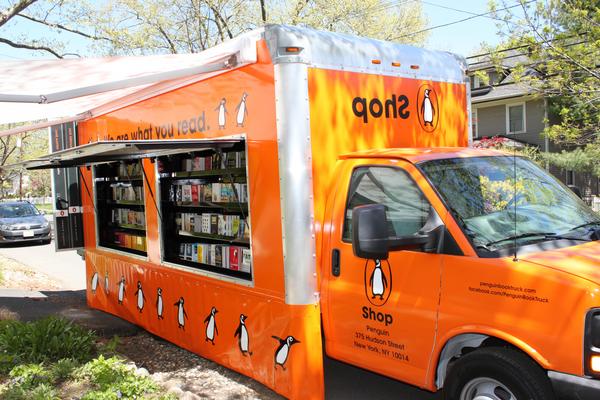 Penguin is launching a “mobile bookstore” akin to the food trucks that have become so popular in urban areas in recent years. They’ll launch the big orange truck (Penguin orange, dontcha know) with a splash at Book Expo America and then roll it through to ALA in Chicago next month.
It’ll carry over a thousand books for sale from not just the Penguin imprint, but also its various other imprints, including Viking, Dutton, Gotham Books and others. It’s a deluxe ride, with an awning to keep customers in the shade as they browse and LED lights for night-time decoration. It also comes equipped with a pushcart to further extend the sales area.
Houston’s ‘murderous’ bookstore thriving in an e-book world
It’s the case of a small neighborhood bookstore that’s thriving in Houston.
Yes, people still read books and they’re not just using their Kindles or e-readers to do it. They’re seeking out specific books — especially those books about murder and mystery.
At Murder by the Book in Rice Village, it’s a real “who-done-it.”
Author Marilyn Johnson (& a few others) Weigh in on Print v Digital
A recent survey found that half of all readers had no interest in buying e-books and that the vast majority of people who buy e-books continue to buy print books as well.
Among them are author Marilyn Johnson, who’s written books about libraries (This Book Is Overdue) and the art of obituary writing (The Dead Beat). She says that “if you took my (physical) books away, I’d go crazy, but now that I’ve gotten hooked to readers (first a Kindle and now an iPad), I can’t imagine doing without that (digital) library.”
She finds her e-reader is essential when she’s traveling. She even buys or borrows an e-book copy of a book she already owns “just to lighten my load and continue reading as I move through the landscape.”
Johnson straddles any divide between print and digital.
Her ideal reading experience crosses all formats: “Hear the author read on an audiobook, read it myself on the page or e-reader, and own it in a beautiful dust jacket, alphabetized on a shelf, with my notes in the margins and an old review stuck in the pages, ready to be pulled down whenever I want.”
Texas county to open “library without books”
Bexar County, Texas, is set to launch a huge project they’re calling “BiblioTech”.
… the BiblioTech library will have 100 e-readers for loan, and an initial selection of 10,000 digital titles. The library itself will have a host of computer stations where patrons can study, use the Internet, and learn computer skills.
Meanwhile, readers at home can check out e-books without leaving the couch. It’s estimated that the library’s services will reach about 1.7 million people in Bexar County, which includes San Antonio. The BiblioTech project is designed to supplement the existing city library system.
We’ve heard of “virtual” libraries before, but what I find interesting about this is the emphasis on e-readers for loan, not just computer terminals or digital holdings. However, I have to wonder how 100 e-readers are meant to serve a population of 1.7 million. I assume that’s just a starting point, but I’m fascinated to see how this model develops and what it will mean for other public libraries and managing digital readership.
Edited to add – “Anonymous” in the comments below is absolutely right to call me out on using “without books” when I meant “paperless.” –Amy
Stephen King nixes e-book version for his latest novel
More than ten years after becoming one of the first novelists to embrace the e-book format, Stephen King has become one of the first novelists to reject it.
King’s book, Riding the Bullet, was published as a one of the first e-books by Simon & Schuster in 2000 and sold for $2.95. Just recently King told the Wall Street Journal that he would withhold digital rights to his upcoming novella, Joyland, to be released in early June. The book will be sold by Hard Case Crime, an independent publisher of crime fiction paperbacks with pulp-style cover artwork. Hard Case Crime also published King’s The Colorado Kid in 2005.
Read more: http://communities.washingtontimes.com/neighborhood/its-about-time/2013/may/21/stephen-king-nixes-e-book-version-his-latest-novel/
Physical Books Are Dead – Long Live Physical Books
We can thank digital for much of the gain, of course, with overall digital sales up a whopping 66%, split between e-book sales (up 134%) and digital fiction sales (up 149%). And yes, physical book sales were down, though with a mere 1% dip, only slightly. But what I’m not sure anyone was expecting was this: Total sales of physical books in the fiction genre actually grew by 3%. Take a bow, Fifty Shades of Grey.
Read more: http://techland.time.com/2013/05/01/physical-books-are-dead-long-live-physical-books/
Recent Comments