Archives

The Secrets of Lyndon Johnson’s Archives

I get a sick feeling in my stomach even now as I remember how long it took to answer that question. I started by looking through the library’s “Finding Aids,” a version of a catalogue, in black looseleaf notebooks, which listed the titles of the file folders in each box. Just for Johnson’s “House of Representatives Papers,” the general files from his eleven years in that body, the time before he became a senator and then President, there were three hundred and forty-nine boxes. And those weren’t the only boxes that contained letters, memoranda, reports, speech drafts, etc., that dealt with this period. There were, for example, the LBJA files, which included documents that Johnson’s staff had, at various times, shifted from the general “House Papers” and put into other groupings—the library calls them “collections”—such as the “Selected Names” files, which contained correspondence and other material with “close associates.” At least it wouldn’t be me alone turning the pages. Working in the Reading Room with me would be Ina, whose thoroughness and perceptivity in doing research I had learned to trust.

From The Secrets of Lyndon Johnson’s Archives, by Robert A. Caro | The New Yorker
Cantor, Stanford Libraries make Warhol photography archives publicly available

Now available through the Stanford Libraries’ SearchWorks catalog, Spotlight gallery, and the Cantor’s website, this archive – of 3,600 contact sheets and 130,000 images – provides a unique ability to view the world through the lens of Warhol’s 35mm camera, which he took with him everywhere he went during the last decade of his life. The collection, which is the most complete collection of the artist’s black-and-white photography ever made available to the public was acquired by the Cantor from The Andy Warhol Foundation for the Visual Arts Inc. in 2014.

From Cantor, Stanford Libraries make Warhol photography archives publicly available | Stanford News

The Internet’s keepers? “Some call us hoarders—I like to say we’re archivists”

The longtime non-profit’s physical space remains easy to comprehend, at least, so Graham starts there. The main operation now runs out of an old church (pews still intact) in San Francisco, with the Internet Archive today employing nearly 200 staffers. The archive also maintains a nearby warehouse for storing physical media—not just books, but things like vinyl records, too. That’s where Graham jokes the main unit of measurement is “shipping container.” The archive gets that much material every two weeks.

The company currently stands as the second-largest scanner of books in the world, next to Google.

From The Internet’s keepers? “Some call us hoarders—I like to say we’re archivists” | Ars Technica

Archivist who skipped work for a decade without anyone noticing spent his free time running a male brothel and drawing erotic comics.

He was paid a 50,000 euro ($80,000) salary as an archives director in Valencia’s provincial government, would show up to the office every morning at 7:30am to clock in using the fingerprint scanner before heading home, only returning to the office at 3:30pm to clock out.

He kept up the routine for 10 years before colleagues began to raise suspicions. After Spanish newspaper El Mundo broke the story 18 months ago, he was finally sacked, despite his insistence that he had done nothing wrong.

“I have only done what they have asked me to do,” he told the paper in January.

From Spanish public servant who skipped work for a decade gets nine-year ban

Lou Reed’s Archive, Coming to the New York Public Library

Anderson, from the beginning, wanted people to have access to the complete collection, and wanted much of it digitized and made available online. So she and Fleming reached out to the performing-arts library, which has extensive music collections and artists’ archives. “We were really impressed with the performing-arts people,” Anderson said.

From Lou Reed’s Archive, Coming to the New York Public Library | The New Yorker

CBC is destroying its broadcast archives after they’re digitized

But internationally accepted standards and best practices of audiovisual preservation call for retention of originals, due to the unknown characteristics of digitization, such as long-term stability and vulnerability to electromagnetic interference, the foundation said.

It also questioned why Radio-Canada was preserving its master recordings after making digital copies but CBC had opted to rely only on digital copies.

“Such inequitable treatment of cultural treasures is not acceptable,” said Wilkinson.

From CBC is destroying its broadcast archives after they’re digitized | The Star

In the Archives: Poison Pages

Originally a byproduct of the European mining industry, arsenic offered mining companies a means of profiting from a waste product, and offered manufacturers a means of obtaining a cheap dye. Thousands of tons were annually imported to the United States. The substance produced lovely hues ranging from deep emerald to pale sea-green. Arsenic could also be mixed into other colors, giving them a soft, appealing pastel appearance.

The first application of arsenic as a pigment was as a paint dye. The pale green shade caught on as a “refined” color. American manufacturers began using arsenic to color a range of consumer goods. Children’s toys were painted with arsenical paint. Arsenic-dyed paper was used in greeting cards, stationery, candy boxes, concert tickets, posters, food container labels, mailing labels, pamphlets, playing cards, book-bindings, and envelopes –envelopes the sender had to lick.

From The Ann Arbor Chronicle | In the Archives: Poison Pages

The Lost Picture Show: Hollywood Archivists Can’t Outpace Obsolescence

These days, nearly all of the films from all of the major studios are shot and edited digitally. Like Lubezki, filmmakers have switched to digital because it allows a far greater range of special effects, filming conditions, and editing techniques. Directors no longer have to wait for film stock to be chemically processed in order to view it, and digital can substantially bring down costs compared with traditional film. Distribution of films is likewise entirely digital, feeding not only the digital cinema projectors in movie theaters but also the streaming video services run by the likes of Netflix and Hulu. The industry’s embrace of digital has been astonishingly rapid.

From The Lost Picture Show: Hollywood Archivists Can’t Outpace Obsolescence – IEEE Spectrum

Radioactive, yes, Radioactive Archives

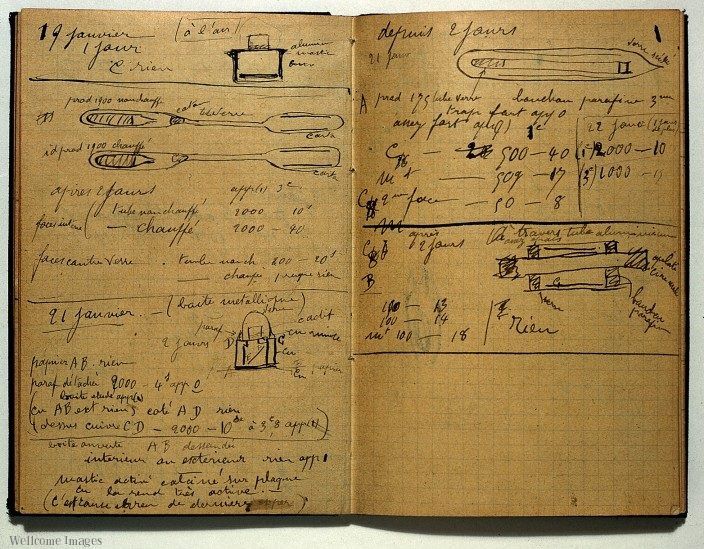
You guessed it, the notebooks of Marie Curie.

Via Open Culture, here’s a report on the papers and other belongings of the discoverer of polonium and radium, Marie Curie who worked in her future husband Pierre’s lab. (I love that movie).

Her notebooks, her clothing, her furniture, pretty much everything surviving from her Parisian suburban house, is radioactive, and will be for 1,500 years or more.

If you want to look at her manuscripts, you have to sign a liability waiver at France’s Bibliotheque Nationale, and then you can access the notes that are sealed in a lead-lined box.