American Library Association

The Future of Libraries: Short on Books, Long on Tech

June 25th article in Time.

Usual mishmash of an article that manages to use shushing and stern librarians.

Has this great typo – “I think there’s some value to the ability to hold a book in one’s hand,” said Maureen Sullivan, president of the American Library Association. “There’s something very special about the tactical experience, a personal connection that happens there.”

I assume they were trying to use tactile. If the article now has the word tactile it is a correction because the word used above was directly out of the article.

Full piece.

Immigration Bill Gets a Library Add-On

Sen. Jack Reed (D-RI) is offering a library amendment to the immigration bill that the Senate is considering this week. The amendment, #1223, would make public libraries eligible for funding for English language instruction and civics education, and would also add Susan Hildreth, the director of the Institute of Museum and Library Services (IMLS) to the Task Force on New Americans. The American Library Association (ALA) is asking its members to call their Senators in support of Reed’s amendment.

According to the Congressional Record, Reed said that the amendment “recognizes the longstanding role that libraries have played in helping new Americans learn English, American

civics, and integrate into our local communities. It ensures that they continue to have a voice in these critical efforts… This amendment expands on the recent partnership between U.S. Citizenship and Immigration Services (USCIS) and IMLS.” He also cited IMLS statistics which say that more than 55 percent of new Americans use a public library at least once a week.

Story from Library Journal.

Penguin to launch “Book Truck”

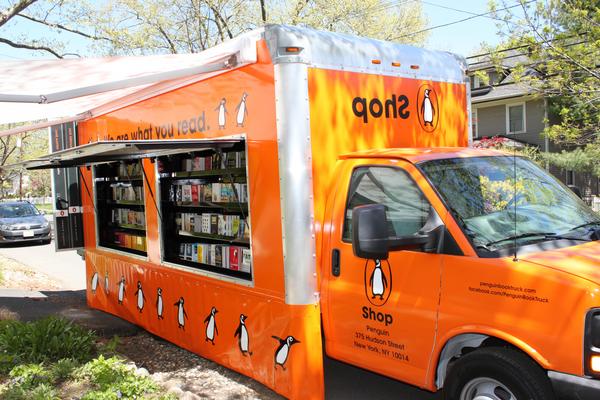
picture of Penguin Book TruckPenguin is launching a “mobile bookstore” akin to the food trucks that have become so popular in urban areas in recent years. They’ll launch the big orange truck (Penguin orange, dontcha know) with a splash at Book Expo America and then roll it through to ALA in Chicago next month.

It’ll carry over a thousand books for sale from not just the Penguin imprint, but also its various other imprints, including Viking, Dutton, Gotham Books and others. It’s a deluxe ride, with an awning to keep customers in the shade as they browse and LED lights for night-time decoration. It also comes equipped with a pushcart to further extend the sales area.

More details in the New York Business Journal

A quick look at the National Digital Library Endowment Plan from LibraryCity.org

Note: For more details, see a longer FAQ at http://librarycity.org/?p=6933. David Rothman’s email is [email protected].

Q. Why a national digital library endowment?

A. U.S. public libraries now spend roughly $1.3 billion a year on books and other content in all formats, around 12 percent of operating expenditures. The figure in the 2010 fiscal year was $1.42 per capita in Mississippi and nationally just $4.22. As reported by the Economist, library sales are approximately 5 percent of those of U.S. book publishers (no wonder the ALA can get only so far in talks with the big publishing conglomerates).

Q. Why should the endowment focus on e-books and other digital content?

A. Costs and greater ease of sharing resources at a national level–while still compensating publishers fairly. Not to mention other possibilities such as reliable interbook links and extensive annotations. Librarians should curate annotations and other user content. The Amazon buyout of Goodreads is an example of the perils of libraries NOT updating their mission.

E-books can efficiently help libraries honor S. R. Ranganathan’s classic Five Laws of Library Science–such as “Books are for use” and “Every reader his book” (or her book). Even academic libraries at well-off universities have limited resources. As for the typical U.S. public library branch, it carries just 4,350 books, a fraction of Amazon’s more than 1.7 million, according to the Economist.

The endowment would at least indirectly free up a bit more money for possible spending on paper books at the local level while still responding to readers’ burgeoning interest in e-books.

Q. How would the plan work?

A. The new endowment could be either a nonprofit or government agency (I favor the latter). The endowment could focus on raising the money, while the existing Institute of Museum and Library Services dealt with challenges of distributing it amid institutional rivalries. Better to separate the raising of the money from the spending. Don’t let the wealthy micromanage the library world, even though librarians certainly should listen to good ideas from anyone, whether Bill Gates or a book-loving janitor.

As donors, the endowment would focus on the super rich, a good way to reduce the overlap with typical local efforts. People like Gates, Warren Buffett, and Larry Ellison could win formal and well-publicized recognition from Congress and the White House for being modern Carnegies in spirit. Gates has been a godsend in certain ways to the library world, but currently isn’t financing zillions of e-books for public libraries even though he could afford it.

Here’s a chance to spotlight Andrew Carnegie’s Gospel of Wealth and appeal to the signers of the Gates-and-Buffett-promoted Giving Pledge, who have agreed to donate at least half of their wealth to philanthropy during or after their lifetimes.

Q. What if the rich won’t give to the endowment?

A. A small endowment is better than none, and besides, if the endowment failed, this would reinforce the argument for more tax money for libraries.

Q. Is this a total solution to libraries’ funding challenges?

A. Absolutely not. Tax money still welcome. The LibraryCity plan also calls for other revenue streams, such as a low-cost, high-volume subscription service that people could join through tax-form checkoffs (with breaks for low-income people).

Q. Would the publishers participate?

A. Large publishers might be holdouts at first, but many small ones would leap at the chance to participate in the subscription service and grow with libraries’ help. The big boys would probably come aboard in time.

As pros at this, librarians could maintain quality control and highlight the better titles from publishers of all sizes. Local and state librarians could link directly to national content (their autonomy is essential, and nothing here would prevent local libraries from buying their own titles).

Nonsubscribers could still have access to everything. They would simply have to wait longer for some of the more popular items from two separate but very tightly intertwined national digital library systems, one public, one academic.

Q, Why two national digital library systems financed by the endowment?

A. As I’ve written at LibraryJournal.com, the needs of typical patrons of public and academic libraries are rather different. Academics as a rule don’t care as much about library-related digital divide issues for the masses, which the public system would help address.

Q. What’s LibraryCity?

A. A public interest site. An ex-poverty beat reporter and creator of the TeleRead e-book site, I cofounded LibraryCity with Tom Peters, now dean of library services at Missouri State University, at his suggestion.

Q. Where can I find the original proposal?

A. http://librarycity.org/?p=6800. A related item on the Atlantic’s site is at http://www.theatlantic.com/national/archive/2013/02/infrastructure-watch-buffett-as-the-next-carnegie/273263/.

Q. How can I help?

A. Librarians could refine the plan with a community FAQ. Meanwhile letters to Congress members would help—encourage them to contact IMLS and the White House, and document the need with local specifics. CC [email protected].
From NPR: American Library Association, Barnes & Noble Called ‘Facilitators Of Porn’

From NPR’s The Two-Way: The American Library Association and Barnes & Noble were among the groups named by conservative group Morality in Media in its “Dirty Dozen List” of “the top 12 facilitators of porn.” The list states that the ALA encourages libraries to have unfiltered computers, and that the bookstore chain “is a major supplier of adult pornography and child erotica.”

The top spot, however, went to U.S. Attorney General Eric Holder for “refus[ing] to enforce existing federal obscenity laws.”

Hat tip to Bobbie Newman @librarianbyday for the lead.

Michael Gorman Reminds Us His Enduring Values Mean Never Try Anything New

Some old-school types have mixed feelings about the push to diversify. “I hope the library doesn’t turn into something that is a type of cooking-class meeting place with computers attached and no books,” says Michael Gorman, former president of the American Library Association and university librarian emeritus at California State University, Fresno.

“If it appeals to youth and the youth are using the library… good luck to you,” Mr. Gorman says, “though personally I would pay good money not to attend a standup comedy evening or a hog butchering.”

[ See Also! ]

Libraries And E-Lending: The ‘Wild West’ Of Digital Licensing?

Have you ever borrowed an e-book from a library? If the answer is no, you’re a member of a large majority. A survey out Thursday from the Pew Internet Project finds that only 5 percent of “recent library users” have tried to borrow an e-book this year.

About three-quarters of public libraries offer e-books, according to the American Library Association, but finding the book you want to read can be a challenge — when it’s available at all.

Full piece — At the top of screen is a button to “click to listen” audio is 7 minutes 50 seconds.

This episode of “All Things Considered” had other pieces about ebooks and publishing in addition to the library one. They were:
Change Is The Only Constant In Today’s Publishing Industry
E-Books Destroying Traditional Publishing? The Story’s Not That Simple
Margaret Atwood’s Brave New World Of Online Publishing

Random House Says Libraries Own Their Ebooks

Let’s violate a journalistic tenet and repeat that headline: Random House says libraries own their ebooks.
For those who have been paying close attention, this is not news. It came up at the Massachusetts Library Association conference in May, it was bruited about at the American Library Association (ALA) annual meeting in Anaheim in June, and it was mentioned in a “corner office” interview I had with Skip Dye, Random House’s vice president of library and academic marketing and sales, during LJ’s virtual ebook summit on Wednesday. But the potential implications of Random House’s stance are not receiving enough attention and consideration.

Full article

Tributes to Harvey Pekar at libraries in Cleveland and inner suburbs

Comic book writer Harvey Pekar, known for the American Splendor series, is reported by The News-Herald as receiving honors from the Cleveland Public Library and the Cleveland Heights-University Heights Public Library System. Apparently the American Library Association has a United for Libraries division which named the branch in Cleveland Heights a Literary Landmark due to its connections with Pekar.

Both libraries are part of the CLEVNET consortium that stretches along the south shore of Lake Erie in Northern Ohio.

On Loving Her Alaskan Library

From the Anchorage Daily News, by Elise Patkotak:

There are great differences between the library of my past and the libraries of the present and future. Some of those differences are simply mindboggling. For instance, in my day a library card meant I could go to a room with a stack of books, choose which I wanted to read and have the books stamped by a nice lady at the desk. Then I got to walk out of the building with my arms full of treasure. Now, a library card means you can sit in the comfort of your own home and download e-books that you can keep for about three weeks before they “return” to the library shelf. How cool is that?

Equally important, perhaps, in a time when we are more and more isolating ourselves from our family and friends through use of electronic media, the library remains a place of vibrant community where ideas can be accessed and shared, discussions held and knowledge gained whether you are rich or poor. It is the ultimate democratizing institution available to everyone in this country.

Today’s reality is that if you can’t afford a computer, you are at a distinct disadvantage in a very competitive world. Go to the library and find free computer access to anyone with a library card. And that card is also, as always, free. In a world where having information at your fingertips is more critical than ever to succeeding, the library is the one place anyone can go to level the playing field.

Read more here: http://www.adn.com/2012/10/09/2655538/libraries-arent-relics-theyre.html#storylink=cpy