American Library Association

New Stonewall Award for Childrens Books

The American Library Association on Monday announced it has added another prize to its Stonewall Book Awards.

The Stonewall Children’s and Young Adult Literature Award will recognize an English-language children’s book “of exceptional merit relating to the gay, lesbian, bisexual and transgendered experience.”

“Children’s books regarding the LGBT experience are critical tools in teaching tolerance, acceptance and the importance of diversity,” Roberta Stevens, president of ALA, said in a statement.

“Our nation is one of diverse cultures and lifestyles and it is important for parents, educators and librarians to have access to quality children’s books that represent a spectrum of cultures,” she added.

In making its announcement, the group cited figures by the U.S. Department of Health and Human Services that show 14 million children are being raised by a gay or lesbian parent and the latest Census data which estimates that more than 56 percent of gay households have at least one child under the age of 18.

Additional coverage in the NYTimes.

Book Bans and Challenges, 2007-2010 Mapped

Book Bans and Challenges, 2007-2010 Mapped
Hundreds of books are challenged in schools and libraries in the United States each year. A challenge is an attempt to remove or restrict materials, while a banning reflects the actual removal of those materials. The American Library Association (ALA) provides confidential support to teachers and librarians and tracks challenges that occur. ALA recorded 460 challenges in 2009 but estimates that this reflects only 20-25% of actual incidents, as most challenges are never reported.

This map is drawn from cases documented by ALA and the Kids’ Right to Read Project, a collaboration of the National Coalition Against Censorship and the American Booksellers Foundation for Free Expression. Details are available in ALA’s “Books Banned and Challenged 2007-2008; 2008-2009; and 2009-2010,”and the “Kids’ Right to Read Project Report.”

K-State Celebrates Banned Books Week

The sign on the podium from which Mary Siegle reads a passage from “Catcher in the Rye” says: THINK for yourself and let others do the same. Kansas State is celebrating Banned Books Week.

This event has been taking place since 2006, during American Library Association’s Banned Books Week. This year’s event began Monday and will continue through Friday.

According to the Office of Intellectual Freedom, there are many specific reasons why books are banned, but the top three reported are: inappropriate language, sexually explicit material and being “unsuited to any age group.”

Many famous, classic novels – some of which are required reading in many high school English curricula – are part of the list of banned and challenged books. For example: “The Great Gatsby,” “To Kill a Mockingbird,” “The Color Purple” and “Gone with the Wind.”

“It’s important to raise awareness of the dangers of censorship and banning books,” said Naomi Wood, associate professor of English. “When books are censored and banned, too often it means that information is being suppressed. Often, individuals want to prevent everyone from accessing information that perhaps only they and a few people like them find objectionable.”

K-State Collegian has the story.

More Thoughts on Banned Books Week

Harry Potter and Huck Finn never met in their adventures, but they’ll share a shelf at libraries across America during Banned Books Week, Sept. 25 to Oct. 2. The weeklong celebration of our freedom to read began in 1982 in response to an increase in the number of books being challenged in the nation’s libraries and schools.
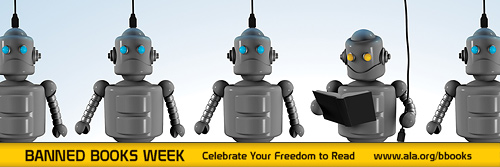
From DePauw University, Greencastle, IN: Banned Books Week has continued annually, and its need has not diminished. According to the American Library Association’s (ALA) Office for Intellectual Freedom, there were 460 recorded attempts to remove materials from libraries last year and many thousands more since the organization began counting in 1990.

Three books by Lauren Myracle — ttyl, ttfn, and l8r, g8r — topped the ALA’s Top Ten List of the Most Frequently Challenged Books of 2009 (see article below). Written entirely in texting shorthand, Myracle’s books were challenged for sexual content and drug references. Stephenie Meyer’s popular Twilight series was challenged on religious grounds, evoking opposition to J.K. Rowling’s Harry Potter novels for promoting witchcraft. And it’s not just new books that are being challenged. Classics such as Harper Lee’s To Kill a Mockingbird and J.D. Salinger’s Catcher in the Rye are perennial contenders for the distinction of being the most challenged book.

Harry Potter and Huck Finn never met in their adventures, but they’ll share a shelf at libraries across America during Banned Books Week, Sept. 25 to Oct. 2. The weeklong celebration of our freedom to read began in 1982 in response to an increase in the number of books being challenged in the nation’s libraries and schools.

From DePauw University, Greencastle, IN: Banned Books Week has continued annually, and its need has not diminished. According to the American Library Association’s (ALA) Office for Intellectual Freedom, there were 460 recorded attempts to remove materials from libraries last year and many thousands more since the organization began counting in 1990.

Three books by Lauren Myracle — ttyl, ttfn, and l8r, g8r — topped the ALA’s Top Ten List of the Most Frequently Challenged Books of 2009 (see article below). Written entirely in texting shorthand, Myracle’s books were challenged for sexual content and drug references. Stephenie Meyer’s popular Twilight series was challenged on religious grounds, evoking opposition to J.K. Rowling’s Harry Potter novels for promoting witchcraft. And it’s not just new books that are being challenged. Classics such as Harper Lee’s To Kill a Mockingbird and J.D. Salinger’s Catcher in the Rye are perennial contenders for the distinction of being the most challenged book.

“Not every book is right for each reader, but we should have the right to think for ourselves and allow others to do the same,” said ALA President Roberta Stevens in a press release on the organization’s website.

Could it Become Illegal to be a Librarian in Alaska?

From Alaska Dispatch:

Alaska librarians and bookstore owners are nervous about new laws they say stifle Alaskans’ First Amendment rights — and after trying unsuccessfully to address their concerns with the governor, they say they’ve got no choice but to sue.

Despite warnings that their attempts to crack down on the ability of sexual predators to entice minors online were seriously flawed, this spring Alaska state legislators and Gov. Sean Parnell went ahead and passed changes to Alaska law that critics claim are unconstitutional.

Senate Bill 222, sponsored by Parnell and introduced to the Legislature at his request, is intended to toughen the state’s human trafficking, sex offense and child pornography laws through increased jail time and more ways for cops to close in on offenders. At the bill signing earlier this year, Parnell touted the legislation, in concert with other crime bills passed that same day, as a package of laws that “better protects children and all victims of assault.”

Incidentally, the anonymous poster who sent in this news item wrote that his/her submission triggered the installed spam filter on the computer and would not be accepted.

Nominate A Library Educator for the LJ Teaching Award

The LJ Teaching Award, sponsored by ProQuest, recognizes excellence in educating the next generation of librarians. This annual award, now in its fourth year, honors the winning LIS teacher with an article in LJ in the November 15 issue, a $5000 prize, and a reception at the 2011 ALA Midwinter Meeting in San Diego.

NOMINATION POSTMARK DATE SEPTEMBER 27, 2010

Please send nominations to:
The LJ Teaching Award
Library Journal
160 Varick St., 11th Floor
New York, NY 10013

or via email to [email protected]

Librarians Deserve a Big Thank You

From the Baltimore Sun: “In advance of Banned Books Week (Sept. 25-Oct. 2) I want to thank the often unheralded defenders of my First Amendment rights — librarians — who have quietly fought and continue to fight censorship. Large amounts of great literature have been banned at one time or another by self-appointed arbiters of the public morality — churches, school boards, censor boards, etc. — because these books have asked questions or described situations that made the rich and powerful uncomfortable or offended someone’s sensibilities.

Works by such great American writers as Sinclair Lewis, Ernest Hemingway, Mark Twain, John Steinbeck and others have been banned and the authors labeled socialist or communist, or blacklisted, because they had empathy for the downtrodden and abused or questioned the actions of the political leadership.

Probably no other group has fought harder against censorship or government snooping into citizens reading habits — or received less public credit for it — than librarians and the American Library Association. This is true, quiet patriotism — standing up for the rights guaranteed by the Constitution, often at the risk of their jobs. They are walking the walk, not just talking the talk. Librarians are high on my list of American heroines and heroes. Thank you!”

Craig Herud, Aberdeen

If They’re Burning Qur’ans, ALA Says ‘We’ll Read Qur’ans’

From American Libraries: Book burning is the most insidious form of book banning, and just as the American Library Association is preparing to celebrate the freedom to read during Banned Books Week, along comes one Rev. Terry Jones of the 50-member Dove World Outreach Center in Gainesville, Florida. The reverend’s idea of world outreach is to commemorate the 9/11 terrorist attacks of 2001 with a public burning of the Qur’an, the Muslim holy book. Gen. David Petraeus had personally pleaded with the reverend to restrain himself because of the potential for retaliatory violence.

Meanwhile, the American Library Association and librarians across the country will move the Qur’an to the top of the Banned Books Week agenda. (Leading the way by modeling tolerance, an Oklahoma public library has been hosting an exhibit of artwork inspired by Muslim tradition.)

“Free people read freely,” says Barbara Jones, director of the ALA Office for Intellectual Freedom. “That is a fundamental principle of the American Constitution and a basic mission of public libraries. We don’t burn books, we read them.”

Thanks to Jenny Levine for the lead.

Possible Joint Conference of ALA and BEA?

Reed Exhibitions, parent company of BookExpo America, is in discussions with the American Library Association regarding the possibility of taking over ALA’s annual convention in June and midwinter meeting in January.

According to Publishers Weekly, the “process is far enough along that Reed has talked to a number of the major trade houses about the prospect and about the idea of combining BEA with the ALA annual meeting.” If a deal is reached, “Reed is believed to favor locating BEA and the ALA annual meeting in 2012 in Chicago, creating in effect two shows under one roof.”

Please cast your vote in our POLL, above.